
Last updated: August 16, 2026
How to Play Pictionary Online: A Beginner’s Guide
Room setup, the exact round timings, how points are actually calculated, and the beginner mistakes that quietly cost you the match.
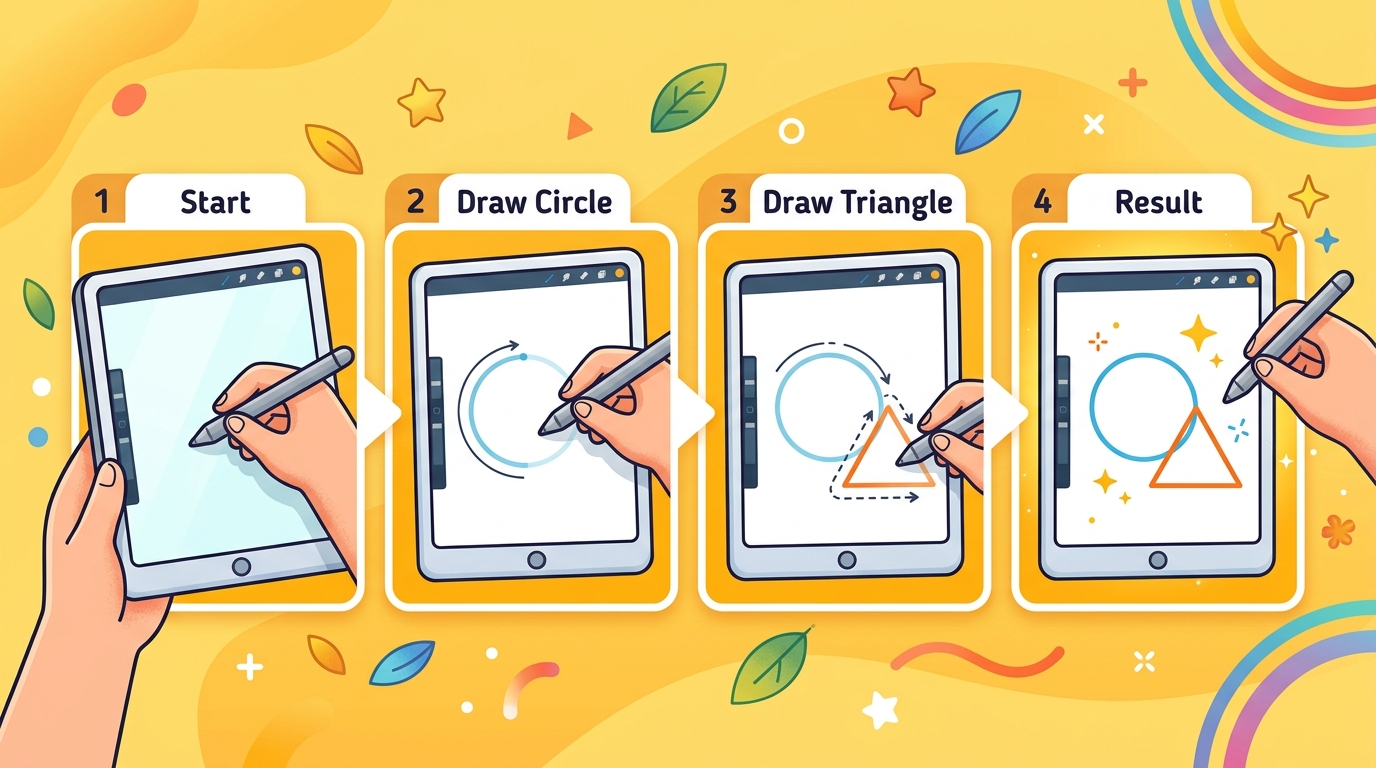
Online drawing games like DoodleGuesser are digital recreations of the classic party game Pictionary. Instead of paper, a pencil, and an egg timer, players draw secret words with a mouse, trackpad, or finger while everyone else races to type the answer into chat. The rules are close enough that anyone who has played the board game will recognise them within one round — but the scoring, the timers, and the etiquette are genuinely different, and that is where new players lose points without understanding why.
This guide walks through a full match end to end: how rooms work, what happens in each of the three phases of a turn, the exact formula used to award points, and the handful of habits that separate a first-timer from someone who finishes in the top three.
1. Creating or Joining a Room
There are two ways into a game, and they suit different situations.
- Private room. Click “Create room” on the homepage. You get a short room code and a shareable invite link. Only people with the link or code can join, which makes this the right choice for a friend group, a family call, or a work icebreaker where you do not want strangers wandering in.
- Quick join. Click “Join room” and you are matched into an active public room with players who are already online. This is the fastest way to get into a game when you have ten spare minutes and nobody to play with.
A room holds up to 8 players. There is no account, no download, and no install step — the room lives entirely in the browser tab, on desktop and mobile alike. One practical detail worth knowing: if the host creates a room and never starts the game, the room releases itself after 60 seconds of inactivity so it does not sit there occupying a code. If the host leaves mid-game, host duties transfer automatically to another player rather than ending the match.
2. The Anatomy of a Turn
A match runs for a configurable 1 to 6 rounds. In each round every player takes exactly one turn as the drawer, so a 4-round game with 6 players means 24 turns in total. Each turn is split into three timed phases:
- Word choice — 15 seconds. The drawer is shown three random words and picks one. Choose deliberately: an easy word gets guessed fast but earns you fewer drawer points overall, while an impossible word risks nobody guessing at all and you scoring zero.
- Drawing — 80 seconds. The drawer sketches; everyone else watches the strokes appear in real time and types guesses. Stroke data syncs in milliseconds, so guessers are watching your line form, not waiting for a finished picture.
- Intermission — 8 seconds. The word is revealed, points are shown, and the turn passes to the next drawer. This is the window to save a drawing to the public gallery or react to what just happened.
The drawing phase ends early if every remaining guesser has already found the word — there is no waiting out the clock once the room has solved it. Disconnected or idle players do not block that early finish.
3. How Scoring Actually Works
Most guides stop at “guess faster, score more”. Here is the real formula, which is worth internalising because it changes how you should play.
As a guesser, a correct answer awards a flat 100 points, plus a speed bonus of up to 100 more, scaled by how much of the 80-second clock is still remaining:
- Guess at 5 seconds in (75s left) → 100 + 93 = 193 points
- Guess at 40 seconds in (40s left) → 100 + 50 = 150 points
- Guess at 75 seconds in (5s left) → 100 + 6 = 106 points
The practical consequence: the difference between first and last correct guess is roughly 90 points, but the difference between guessing late and not guessing at all is a full 100. Never give up on a word because you think you are too late — a 106-point salvage still beats zero, and over a 24-turn match those salvages decide the leaderboard.
As the drawer, you earn 40 points for every player who guesses correctly. With five other players in the room, a word everyone gets is worth 200 points to you — competitive with a fast guess. If nobody solves it, you score nothing. This is the key strategic insight for new players: your incentive as a drawer is maximum comprehension, not artistic ambition. A crude but instantly readable sketch that all five players solve beats a beautiful one that only two people decode.
4. Canvas Controls
The toolbar is deliberately small so there is nothing to learn mid-turn:
- Brush. Draw lines, with selectable colours and stroke widths.
- Fill. Flood-fill an enclosed area — far faster than shading by hand.
- Eraser. Remove specific parts without touching the rest.
- Undo. Step back one stroke. Your most-used key under time pressure.
- Clear. Wipe the canvas and restart. Use sparingly; you rarely have the seconds to spare.
Everything works with a finger on mobile as well as a mouse on desktop. If you are on a phone, turning it to landscape roughly doubles your usable canvas width, which matters more than any brush setting.
5. What You Will Be Asked to Draw
The default word bank contains 2,035 words, each translated across nine languages, spread over 15 themed categories. Knowing the distribution tells you what to expect:
- Everyday objects — 285 words, the single largest group
- Food — 194, and animals — 173
- Places — 161, nature — 158, people — 140
- Vehicles — 133, sports — 124, toys — 124
- Clothing — 118, fantasy — 104, technology — 98
- Music — 93, body — 80, shapes — 50
Roughly two thirds of the bank is concrete, physical nouns — things with a recognisable silhouette. That is good news for beginners: outline shape carries far more of the guess than detail does, so practising fast, confident silhouettes is the highest-value skill you can build.
Hosting a private room also unlocks custom word packs. Paste in your own list — inside jokes, a class vocabulary set, film titles — and the room draws from that instead. It is the single feature that turns the game from a generic time-filler into something specific to your group.
6. Five Mistakes New Players Make
- Writing letters or numbers. Universally considered cheating in Pictionary, and it defeats the point of the game. Draw the thing, not its name.
- Starting with detail. Beginners often draw an eye, then a nose, then realise 50 seconds have gone. Block out the overall shape first; add detail only if time remains.
- Guessing silently. Only typed guesses score. Correct answers are hidden from other players, so there is no reason to hold back — spam your guesses freely.
- Going quiet as the drawer. If nobody is close, redraw from a different angle rather than adding more detail to a sketch that is not landing.
- Idling. A drawer who makes no strokes for 20 seconds is treated as away and the turn moves on. Draw something, even badly, within the first few seconds.
Ready to Play?
You now know more about the scoring than most regular players do. Create a room, send the link to a few friends, and expect your first match to be chaos — that is the correct outcome. The fundamentals click somewhere in round two, and from there it is just practice at drawing fast and guessing faster.