
Last updated: August 16, 2026
How to Win: 10 Expert Drawing and Guessing Tips
Ten tactics derived from how the scoring actually works — not generic art advice.
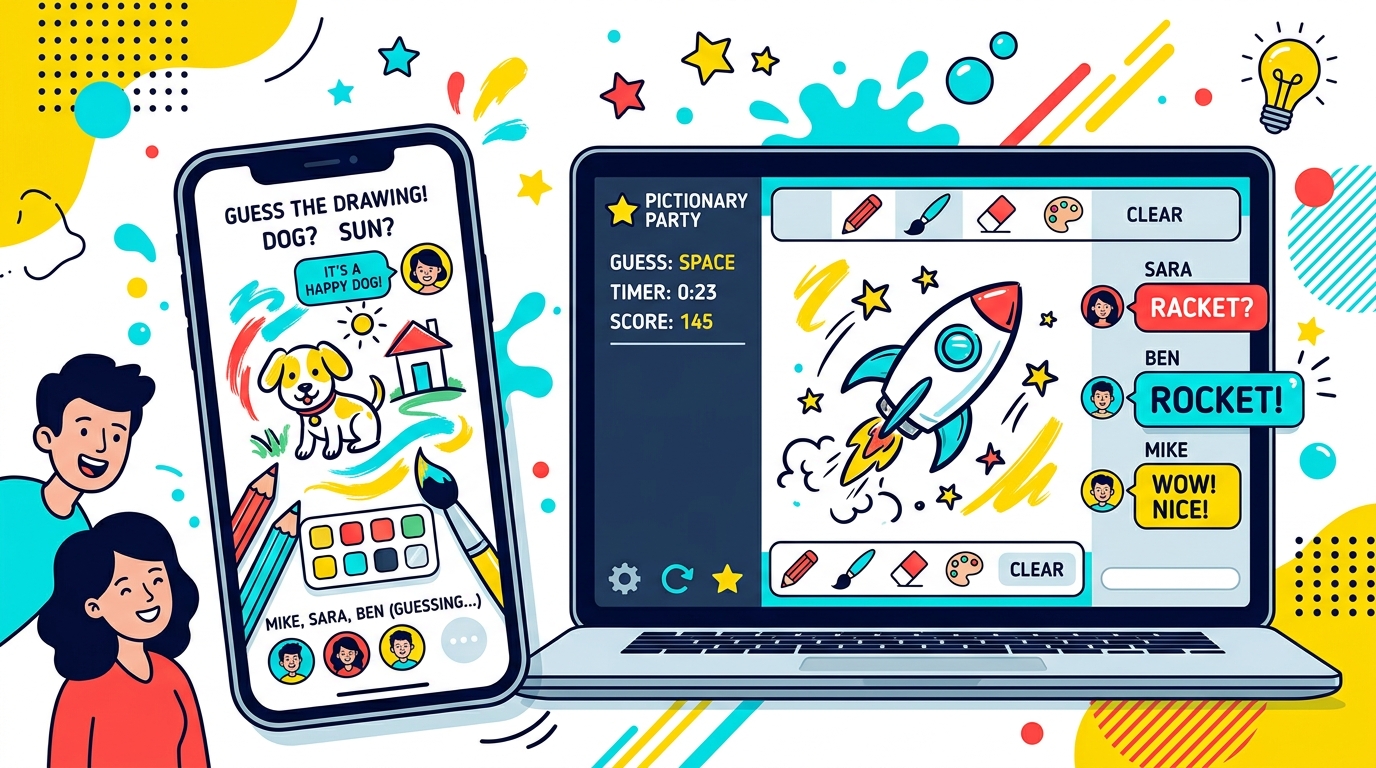
Almost every “Pictionary tips” list is really a drawing-lesson list: use bold lines, think in shapes, practise your proportions. That advice is not wrong, but it ignores the thing that actually determines who wins an online match — the scoring maths. In DoodleGuesser a correct guess is worth 100 points plus up to 100 more depending on how much of the 80-second clock is left, and the drawer collects 40 points for every player who solves the word. Every tip below follows from those two numbers.
1. Draw the Silhouette Before Anything Else
Recognition happens at the level of outline, not detail. Human visual processing identifies an object from its overall contour long before it registers texture or features, which is why a five-stroke outline of an aeroplane gets guessed faster than a half-finished cockpit rendered in loving detail. If the word is “aeroplane”, put down the fuselage, wings, and tail in the first ten seconds. Windows and jet trails are optional decoration you add only if the room is still stuck.
This matters more than it sounds. Since the drawer earns per solver, an outline that six people recognise in fifteen seconds is worth 240 points to you. A detailed illustration that two people eventually decode is worth 80.
2. Treat Word Choice as a Risk Calculation
You get 15 seconds and three options. Beginners pick whichever word they feel most confident drawing. That is the wrong frame — you should be picking the word the room is most likely to solve. A word you can draw beautifully but which is conceptually ambiguous (“freedom”, “progress”) will earn you less than a word you draw clumsily but everyone recognises (“ladder”, “umbrella”).
The safe heuristic: prefer concrete physical nouns with a distinctive silhouette. Around two thirds of the 2,035-word default bank falls into that group, so you will usually have at least one such option among your three.
3. Never Stop Guessing, Even Late
The speed bonus creates an illusion that late guesses are worthless. Run the numbers: a guess with 5 seconds remaining still scores 106 points, while not guessing scores zero. The gap between a fast guess and a slow one is about 90 points; the gap between a slow guess and no guess is 100. Over a full match, players who keep typing until the buzzer consistently out-score players who give up when they fall behind.
4. Guess in Volume, Not in Precision
Correct answers are hidden from other players, and there is no penalty for a wrong guess. There is therefore no strategic reason to hold back a half-formed idea. Type “dog”, “wolf”, “fox”, “coyote” in quick succession rather than waiting to be sure. Volume guessing also helps the drawer: they can see the room converging on the wrong animal and correct course.
5. Use Colour as Information, Not Decoration
Switching colours costs you a second or two, so each switch should carry meaning. Yellow for a banana or the sun, red for an apple or a fire engine, blue for water — colour can eliminate an entire branch of wrong guesses instantly. What it should never be is aesthetic: shading a grey sky behind your object burns fifteen seconds and communicates nothing.
The fill tool is the exception worth learning. One click floods an enclosed shape, which is far faster than colouring by hand and often the difference between a recognisable red apple and an ambiguous circle.
6. Show Scale With a Reference Object
A great many words are only distinguishable by size. A mouse and an elephant have broadly similar four-legged silhouettes at small scale. Draw a stick figure next to your subject and the ambiguity disappears in one stroke. The same trick separates “boat” from “ship”, “knife” from “sword”, and “hill” from “mountain”.
7. Draw the Action, Not Just the Object
For verbs and abstract prompts, the object alone is a dead end. Motion lines, sweat drops, impact stars, and a thought bubble are the visual grammar of the genre and everyone understands them. “Sleeping” is a figure plus three Z’s. “Running” is a figure plus speed lines. “Cold” is a figure plus wavy lines and a blue tint. Learn the dozen or so standard symbols and abstract words stop being frightening.
8. Undo Is Faster Than Erase
Under time pressure, most people reach for the eraser and spend eight seconds carefully scrubbing a bad line. Undo removes the last stroke instantly. Build the habit of undoing immediately rather than assessing whether the line is salvageable — you can always redraw it, and the seconds you save go straight into the drawer’s score.
Clear, by contrast, should be a last resort. Wiping the canvas at the 40-second mark leaves you half the time and a room that has lost its train of thought.
9. Pivot When the Room Is Stuck
Watch the chat. If forty seconds have passed and nobody is close, adding more detail to the same sketch will not help — the guessers have already committed to a wrong interpretation. Clear a corner of the canvas and draw the object from a completely different angle, or draw its context instead of the object (for “saddle”, draw a horse). A second, different attempt is worth far more than a more polished first one.
10. Fix Your Setup Before You Fix Your Technique
On mobile, rotating to landscape roughly doubles your usable canvas width, which improves your drawings more than any amount of practice. On desktop, a trackpad is genuinely harder than a mouse for smooth curves — if you only have a trackpad, draw in short confident segments rather than attempting long continuous strokes.
Whatever your input device, get a stroke on the canvas within the first few seconds. A drawer who makes no marks for 20 seconds is treated as away and the turn moves on — an easy way to score nothing through hesitation alone.
Putting It Together
The through-line in all ten tips is the same: online Pictionary rewards communication speed, not draughtsmanship. Every second you spend making a drawing better-looking rather than more legible is a second working against your own score. Players who internalise that usually see their placement improve within a handful of matches — no drawing ability required.