
Last updated: August 16, 2026
Solo Draw and Gallery: Practising Without the Clock
The two single-player modes, and how to use them as actual practice rather than as a distraction.
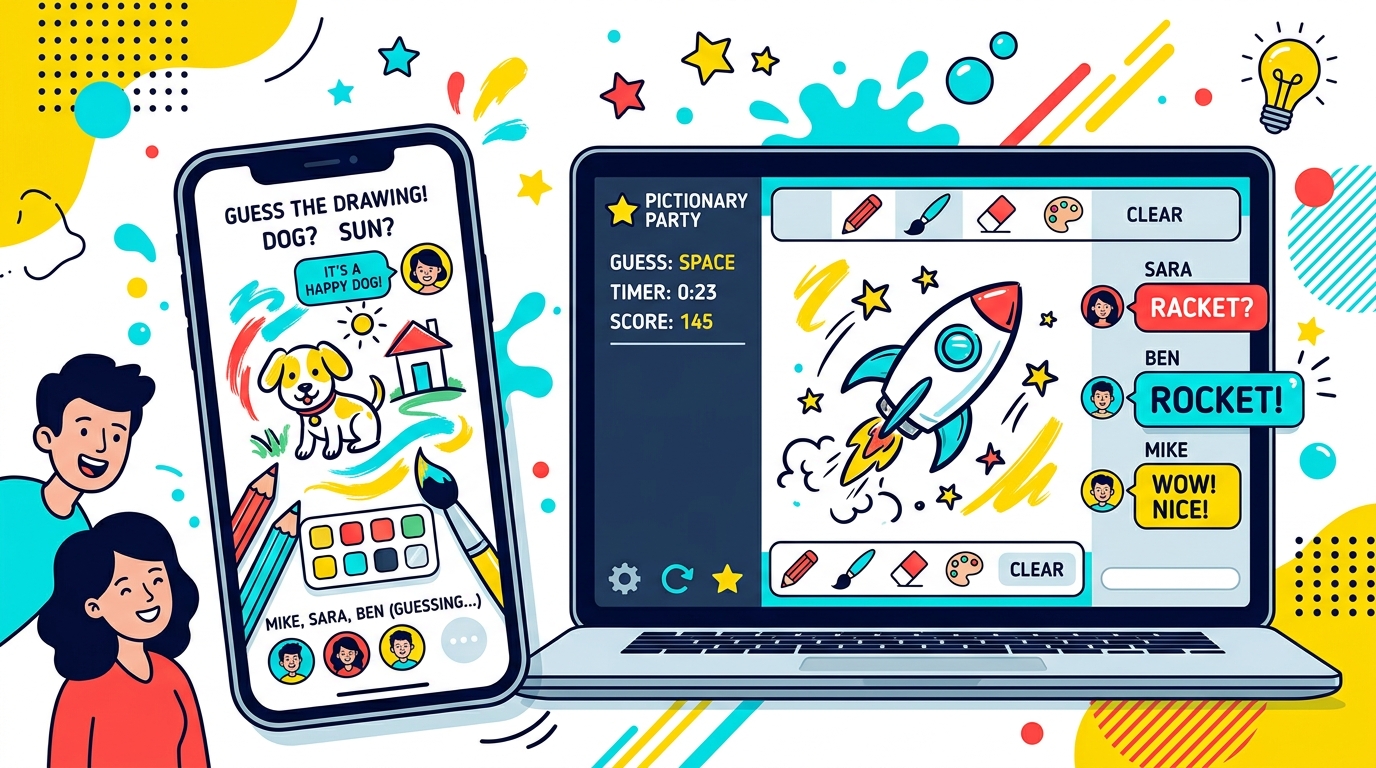
Trying to learn drawing technique during a live match does not work. You have 80 seconds, five people waiting, and a scoreboard — which is precisely the wrong environment for deliberately changing a habit. Any new technique feels slower at first, and under that pressure you will abandon it within one turn.
Two single-player modes remove the pressure entirely. Used casually they are a pleasant way to pass ten minutes; used deliberately they are the fastest way to improve.
Solo Draw: Practice With No Clock
Solo Draw hands you a random word from the 2,035-word bank and an empty canvas, with no timer and nobody watching. You get the same tools as in a match — brush, colours, fill, eraser, undo, clear — and can request a new word whenever you like. When you are finished you can save the drawing to the public gallery, share it as an image, or simply move on.
The value is that you can do the same word three times in a row and compare. That is impossible in a match, and it is how technique actually changes.
Four Drills That Transfer to Matches
Aimless doodling in Solo Draw is enjoyable but does not make you better at the game. These four drills target the specific things that decide rounds.
- 1. The ten-second silhouette. Take a word and give yourself ten seconds for the outline only — no features, no colour. Then stop and ask whether it is identifiable. Recognition happens at the silhouette level, so this drill trains the part of drawing that actually scores. Ten words in five minutes.
- 2. Signature-feature isolation. Pick an animal or object and draw only its one identifying feature — the giraffe’s neck, the chef’s hat, the lighthouse’s beam. This builds the instinct to lead with the distinguishing element rather than building up to it.
- 3. Same word, three ways. Draw one word from three different angles or approaches. In a match, when the room is stuck at forty seconds, the correct move is to redraw differently rather than add detail — but only if you have a second approach ready. This drill builds that stock.
- 4. Fill-and-colour speed. Practise outline-then-fill on coloured objects: apple, banana, fire engine, sun. Food and vehicles depend heavily on colour, and the fill tool is much faster than shading — but only once the habit is automatic.
Ten minutes across these four drills will do more for your match performance than an hour of playing, because in a match you spend most of your time guessing rather than drawing.
Mobile Players Should Start Here
If you play on a phone, Solo Draw is where the two big mobile fixes should be learned, because both feel wrong at first.
- Landscape orientation roughly doubles your canvas width, but it changes where everything sits. Ten minutes of Solo Draw in landscape makes it feel normal.
- Drawing top-to-bottom so your hand never covers your work in progress is genuinely awkward for the first few attempts and automatic after about twenty.
Neither of these is something you want to be learning while five people watch a blank canvas and the idle timer runs.
The Gallery: Guessing as Practice
The gallery collects drawings that players chose to keep — everything from genuinely skilled sketches to complete failures. Guess the Doodle mode serves you random community drawings to identify.
This is more useful than it sounds, for a reason that is not obvious: studying other people’s failed drawings teaches you what not to do. When you cannot identify something and then see the answer, you have just learned a specific way a drawing can fail to communicate — usually too much detail, wrong angle, or no scale reference. That lesson transfers directly to your own turns.
It also trains raw guessing speed, which matters more than most players appreciate. In a six-player room you guess on five turns for every one you draw, so guessing is where the majority of your available points live.
What to Save, and What Not To
Both Solo Draw and the end-of-match results screen let you save a drawing to the public gallery under a name you choose. A few things worth knowing:
- The gallery is public. Anyone on the internet can view it, not only people from your room.
- Your chosen name is shown alongside the drawing, so use something you are happy to have public.
- Drawings can be removed by their drawer from the results screen.
- Anything inappropriate can be reported, and reported drawings are hidden automatically.
On what is worth saving: the disasters, generally. A competent drawing of a house is not interesting to anybody. A drawing that is so wrong the room spent eighty seconds shouting the wrong animal is the one people will actually enjoy finding later.
Using Solo Draw to Test a Word Pack
If you host game nights with custom word lists, Solo Draw doubles as a testing ground. A pack that reads brilliantly can play terribly, and the failure mode is always the same: prompts that are funny to write but have no obvious first stroke.
Take five entries from your list and draw them unhurried. Anything that takes you ninety seconds without a clock is unplayable in an 80-second round with an audience. Cutting those three or four entries before the session is the difference between a pack that lands and one that produces a flat stretch in the middle of the match.
What Guess the Doodle Teaches About Guessing
Working through community drawings surfaces a pattern that is hard to notice mid-match: most of your wrong guesses come from committing too early. You decide it is a dog at eight seconds, and then you spend the next forty seconds fitting every new stroke into the dog theory rather than reconsidering.
Guessing in the gallery, with no clock and no competition, is where you can catch yourself doing it. The habit worth building is deliberately generating a second hypothesis — asking “what else could this be?” before typing again. In a live round that is worth real points, because a guesser who re-evaluates at forty seconds still scores 150.
A Realistic Practice Routine
Nobody wants a training schedule for a party game. But if you would like to be noticeably better by your next game night, this is about the minimum that works:
- Once: ten minutes of Solo Draw running the four drills above, in landscape if you are on a phone.
- Occasionally: five minutes of Guess the Doodle before a session — it warms up the pattern-recognition you will rely on all evening.
- During matches: apply exactly one new habit at a time. Trying to change silhouette-first drawing, colour discipline, and guessing volume simultaneously means changing none of them.
The realistic ceiling here is worth being honest about: this will not make you a good artist. It will make you a considerably better communicator under time pressure, which is the only skill the scoreboard measures.