
Last updated: August 16, 2026
Drawing on Mobile Screens: Finger vs. Stylus
Why phone drawings look worse, what actually fixes it, and whether a stylus is worth buying.
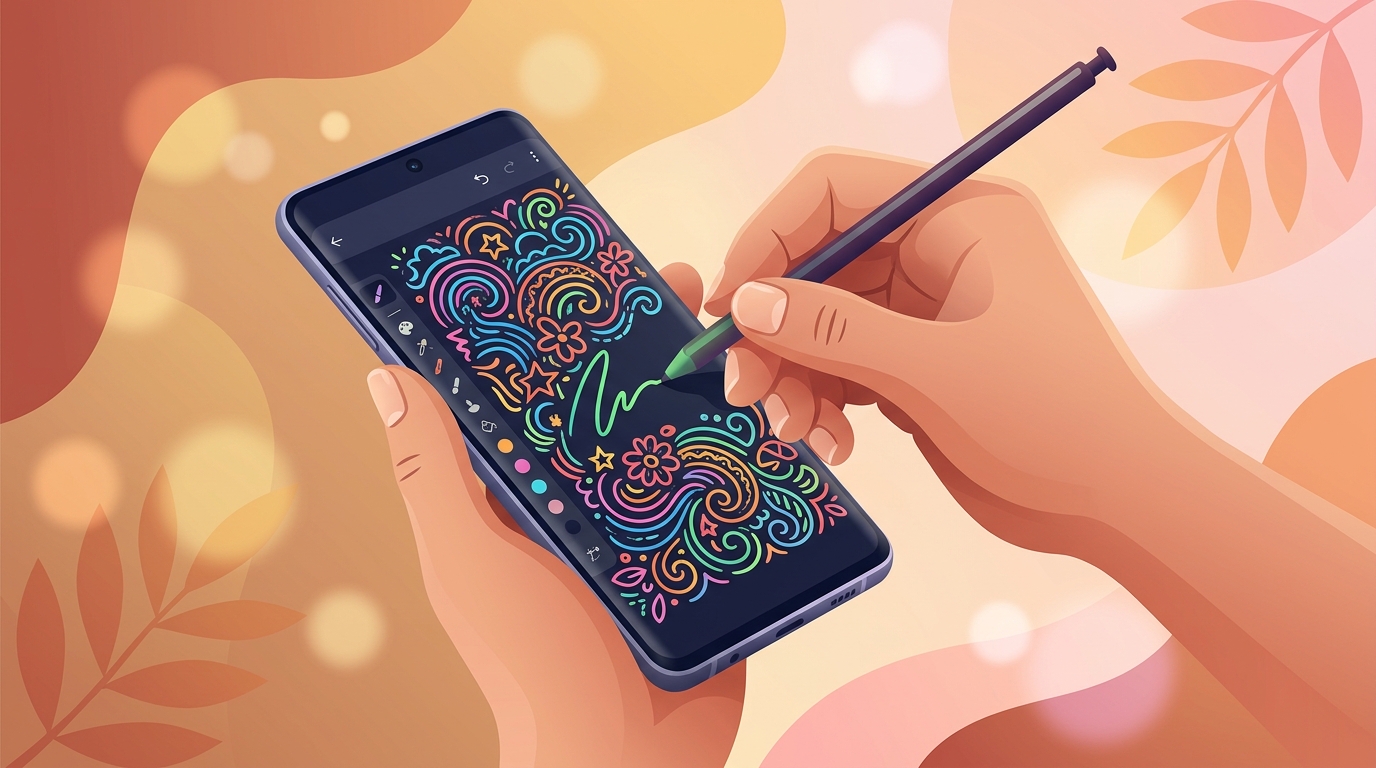
A large share of drawing-game players are on a phone, and phone drawings are visibly worse than desktop ones. The usual explanation — “fingers are imprecise” — is only part of it, and fixing the wrong part is why most people never improve.
There are three separate problems on mobile, and they have different solutions. Two of them can be fixed in about five seconds, before you have practised anything at all.
Problem 1: Your Hand Covers the Canvas
This is the big one, and it is not about precision. When you draw with a finger, your hand occludes the area you are drawing into. On a desktop you see the whole canvas continuously; on a phone you are working blind in the lower half of your own drawing.
The fix costs nothing: draw top-to-bottom and left-to-right (right-to-left if you are left-handed), so your hand always covers the part you have already finished rather than the part you are about to draw. It feels unnatural for about one round and then becomes automatic.
The related habit is to lift and check. Every few strokes, take your hand fully off the screen and look at the whole canvas. Guessers are seeing your strokes appear live, so what matters is the overall shape, and the overall shape is exactly what you cannot see while drawing.
Problem 2: You Are in Portrait
Most people play in portrait because that is how they hold a phone. But a drawing canvas is typically wider than it is tall, so portrait mode gives you a small canvas in the middle of the screen with wasted space above and below.
Rotate to landscape. On most phones this roughly doubles the usable canvas width. It is the single highest-impact change available to a mobile player and it takes one second. If you do nothing else in this guide, do this.
The trade-off is that the chat panel gets narrower, which matters more when you are guessing than when you are drawing. A reasonable habit is to rotate to landscape for your drawing turn and back to portrait while guessing.
Problem 3: Actual Precision
A fingertip contact patch is several millimetres across, so the screen has to guess where you meant to touch. This genuinely does limit fine detail — but it matters far less than people assume, because fine detail is not what wins rounds.
Recognition happens at the silhouette level. A guesser identifies an aeroplane from its wing and fuselage outline, not from the cockpit windows. Since you only have 80 seconds and the drawer earns points per person who solves the word, the optimal mobile strategy is to draw large, bold, simple shapes — which is exactly what a finger is good at.
Put differently: the precision limit is real but it constrains the part of drawing that does not score. Do not spend money solving it until you have solved the two problems above.
Finger vs. Stylus: An Honest Comparison
Finger — advantages:
- Always available; nothing to find, charge, or lose
- Faster for large sweeping shapes and filling motions
- Zero cost, zero setup
Finger — disadvantages:
- Occludes the canvas as described above
- Poor at small detail and tight curves
- Fingerprints progressively obscure the screen
Stylus — advantages:
- A precise, visible contact point — you can see exactly where the line starts
- Much less occlusion, since a thin barrel blocks far less than a hand
- Smoother long curves, because a pen grip is more stable than a pointed finger
Stylus — disadvantages:
- Must be within reach when the round starts; a 15-second word-choice window is not long enough to go and find one
- Cheap capacitive styluses with rubber tips are often worse than a finger — high friction and inconsistent registration
- Active styluses (Apple Pencil, S Pen) are genuinely good but are not worth buying for a party game alone
The verdict: if you already own an active stylus, use it — it is a clear improvement. If you would need to buy one, do not. A finger in landscape orientation, drawing top-to-bottom, beats a budget rubber-tipped stylus in portrait by a wide margin.
Technique Adjustments for Touch
- Draw in segments, not single strokes. Long continuous curves drift on touch screens. Three short confident arcs read better than one wobbling line.
- Use a thicker brush. Thin lines expose every tremor; thick lines hide them and are more legible at a glance on someone else’s small screen.
- Undo, do not erase. Erasing accurately with a finger is slow and imprecise. Undo removes the last stroke instantly — build the reflex.
- Use fill instead of shading. Hand-shading an area on a phone is painful and slow. One tap floods an enclosed shape.
- Draw bigger than feels right. Small drawings that look fine on your screen become unreadable on someone else’s. Fill the canvas.
Practising Without the Pressure
Learning these habits mid-match is stressful, because a drawer who makes no strokes for 20 seconds is treated as away and the turn passes. Solo Draw mode removes the clock entirely: you get a random word and can draw at your own pace, then save the result to the gallery or discard it.
Ten minutes of Solo Draw in landscape, deliberately practising top-to-bottom construction and thick-brush silhouettes, will do more for your mobile play than a dozen live matches spent fighting the interface.
Guessing on Mobile Is a Separate Skill
Almost all mobile advice covers drawing, but you spend far more of a match guessing — with five other players in the room, roughly five sixths of your time. The mobile constraints there are different and mostly about typing.
- Turn off autocorrect if you can. It is actively hostile here, because word fragments and rapid-fire single nouns are exactly what it likes to rewrite. Nothing is more frustrating than a correct guess silently changed to something else.
- Send short and send often. Wrong guesses cost nothing and correct answers are hidden from other players. Typing “cat” then “dog” then “fox” beats composing one considered answer.
- The keyboard eats the canvas. On most phones the on-screen keyboard covers half the screen, so you are guessing from a partial view. Dismiss it periodically to see the full drawing, then bring it back.
- Portrait is better for guessing. The chat panel is wider and the keyboard takes proportionally less room. This is why rotating per phase — landscape to draw, portrait to guess — is worth the second it costs.
Since a correct guess is worth 100 points plus a speed bonus of up to 100 more, shaving a couple of seconds off your typing is worth roughly as much as any drawing improvement. Mobile players who fix their keyboard setup usually climb the scoreboard before they ever draw better.
Device and Setup Notes
- Clean the screen before you play. Trivial, and genuinely effective — an oily screen causes skipped and stuttering strokes that look like lag but are not.
- Take the case off, or at least check it. Thick cases with raised edges catch the side of your hand near the canvas border, which is where a lot of “my line went wrong” moments come from.
- Tablets are the best of both. Large canvas, touch input, and enough room for the chat panel alongside. If you have one, use it over both phone and laptop trackpad.
- Trackpads are worse than phones. A laptop trackpad is genuinely the weakest input device for this — indirect, small, and awkward for curves. If your choice is trackpad or phone, take the phone.
- Battery saver mode can throttle the canvas. Some phones reduce frame rate aggressively, which makes your own strokes feel delayed. Turn it off before a session.
Summary
- Rotate to landscape to draw, portrait to guess
- Draw top-to-bottom so your hand never covers your work in progress
- Thick brush, large shapes, silhouette first
- Undo instead of erase; fill instead of shade
- Turn off autocorrect — it costs you more points than your drawing does
- Use a stylus only if you already own a good one