
Last updated: August 16, 2026
A Brief History of Sketching and Drawing Party Games
Drawing games are older than the board game that made them famous — and the online versions solved a problem the physical ones never could.
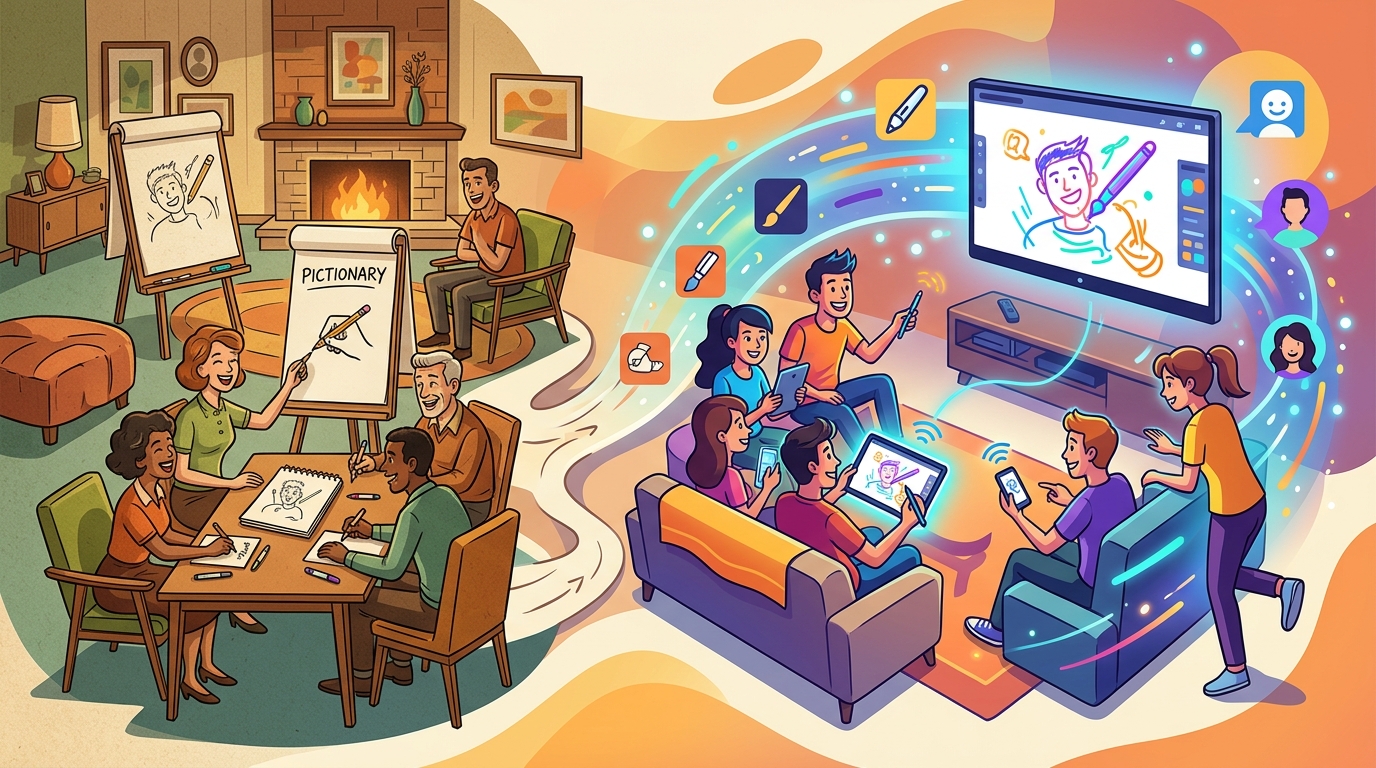
Drawing games feel like a modern invention, or at least a 1980s one. They are considerably older. The core mechanic — one person renders a concept without words while others race to name it — appears in parlour-game collections well before any commercial product existed, and it has survived every change of medium since because the mechanic itself is almost indestructible.
What follows is the short version of how it got from a Victorian drawing room to a browser tab.
Before the Board Game: Parlour Games
Nineteenth-century parlour-game books describe drawing-and-guessing pastimes under various names, played with paper and pencil by families and house guests. They sit alongside charades — the acting-based cousin of the same idea — and share its essential structure: a known concept, a communicator forbidden from using words, and an audience under time pressure.
These games needed no equipment beyond paper, which is why they spread informally and why no single inventor can be credited. A version circulated in German-speaking countries under the name Winkelspiel; English-language collections describe near-identical games. The mechanic was essentially folk knowledge long before anyone thought to sell it in a box.
1985: Pictionary Formalises the Rules
The decisive moment came in 1985, when Rob Angel published Pictionary — reportedly developed by playing the informal version with friends and noting which words worked. The commercial innovation was not the mechanic, which already existed, but the packaging of it:
- A curated word list, sorted into categories and difficulty tiers
- A fixed timer, converting a leisurely pastime into a pressured one
- A board and scoring system, giving the session a defined end
- An explicit prohibition on letters, numbers, and speaking
That last rule is the one that made it a game rather than an activity. Without it, the fastest strategy is to write the word down. Every digital descendant has inherited the rule unchanged, and it remains the only universal etiquette convention in the genre.
Pictionary became one of the defining party games of the late 1980s, and its name became the generic term for the format — much as “Ping-Pong” did for table tennis.
The 2000s: Early Digital Attempts
The first digital versions arrived with Flash-era web games and early console party titles. They faced a hard technical constraint: drawing is a continuous, high-frequency stream of coordinates, and the internet connections of the period were not well suited to relaying it in real time to several people at once.
The workarounds were unsatisfying. Some versions transmitted only the finished image, which removed the best part of the game — watching a drawing take shape and guessing halfway through. Others accepted visible lag, so guessers saw strokes appear seconds after they were made. Console versions using motion controllers had the opposite problem: excellent local drawing, but everyone had to be in the same room, which is exactly the limitation a digital version should have removed.
The 2010s: The Browser Boom
Two developments changed this. WebSockets gave browsers a persistent, low-overhead, two-way connection, making a continuous stroke stream practical without plugins. HTML5 Canvas replaced Flash as a drawing surface that worked everywhere.
The result was a wave of browser drawing games in the mid-2010s, of which Skribbl.io became the best known. The formula they established is still the standard: join by link with no account, take turns drawing from a shared word bank, type guesses into a chat panel, score by speed. No download, no install, no purchase.
This is the point at which the online version stopped being a compromised imitation of the board game and started being better at some things — an infinite word bank, automatic scoring, and no need for anyone to be in the same building.
2020: The Pandemic Surge
Lockdowns produced a sudden global demand for things groups could do together while apart, and drawing games were unusually well suited: they required no equipment, no skill, and no scheduling beyond a shared link. Existing titles saw large audience growth and new formats appeared, most visibly Gartic Phone, which combined drawing with the telephone game and abandoned competitive scoring in favour of a collective reveal at the end.
That period also shifted the platform mix decisively toward mobile. Games designed for a mouse suddenly had to work for a thumb on a phone screen, which drove a round of interface simplification — fewer tools, larger targets, canvases that adapt to the device.
Where the Genre Is Now
Modern browser drawing games are largely a distributed-systems problem rather than a graphics one. The remaining engineering challenge is latency: keeping several players’ views of the same canvas consistent, in real time, wherever in the world they are sitting.
Current approaches place each room’s authoritative state on a server geographically near its players, rather than routing everything through one central region — which is how DoodleGuesser uses Cloudflare Durable Objects. The visible result is simply that strokes appear as they are drawn, which is the experience the 1985 board game had for free and which took the digital versions roughly twenty-five years to reclaim.
The other modern direction is customisation. Physical Pictionary shipped a fixed word list; online versions let a host paste in their own. Word packs made of a group’s inside jokes, a classroom’s vocabulary unit, or a company’s product names produce games no boxed edition could, and it is arguably the genre’s only genuinely new idea since 1985.
Why the Mechanic Survives
Across parlour rooms, board games, consoles, and browsers, the rules have barely changed. The durability comes from a rare property: being bad at it is more entertaining than being good at it. A skilled drawer produces a correct answer; an unskilled one produces a story the group retells afterwards.
Very few games are improved by incompetence. That is why this one keeps being reinvented for whatever medium comes next — and why the version that ends up on whatever replaces the browser will almost certainly still forbid you from writing letters on the canvas.