
Last updated: August 16, 2026
50+ Food Pictionary Words: From Snacks to Exotic Cuisines
Food is the second-largest category in the word bank — and the one where colour does most of the work.
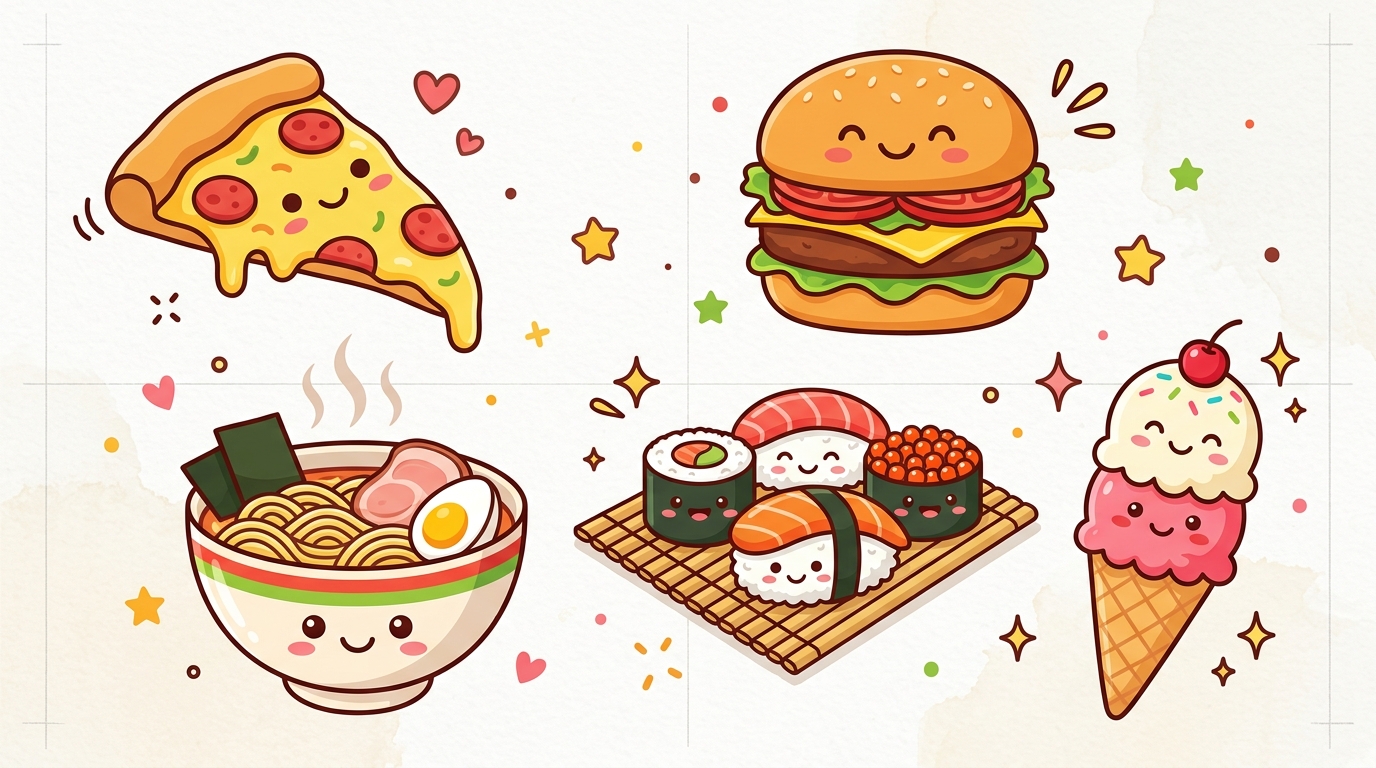
With 194 entries, food is the second-largest category in the DoodleGuesser word bank, behind only everyday objects. It is also the category where the standard advice — draw the outline, skip the detail — partially breaks down. A great many foods share the same silhouette. An apple, an orange, a peach, and a tomato are all a circle with a stem.
What separates them is colour, and that makes food the one category where reaching for a different brush colour is always worth the second it costs.
Why Food Is Harder Than It Looks
Three distinct problems show up in this category, and recognising which one you are facing tells you how to draw the prompt:
- The circle problem. Round fruits are visually identical in outline. Colour and one distinguishing mark solve it: a leaf for the apple, dimpled skin for the orange, a crease for the peach, a green sepal for the tomato.
- The container problem. Soups, drinks, and sauces have no shape of their own — they take the shape of what holds them. Draw the vessel first, then indicate the contents.
- The cultural problem. The bank is deliberately international, so it includes items that are instantly obvious in one region and unknown in another. Mooncake, shumai, and loquat are everyday words for some players and complete mysteries to others.
Easy: Universally Recognised
These are solved fast in almost any room, in almost any language. Good for warm-ups and mixed groups.
- Fruit: apple, banana, watermelon, grape, strawberry, pineapple, lemon, cherry, pear
- Fast food: pizza, hamburger, hot dog, french fries, sandwich, fried chicken
- Sweets: ice cream, cake, cookie, doughnut, lollipop, cupcake, birthday cake, popsicle
- Basics: bread, egg, cheese, milk, corn, carrot, mushroom soup, popcorn
Watermelon deserves special mention as possibly the single easiest word in the entire bank: a green arc, a red interior, three black seeds. Three colours, five strokes, near-universal recognition.
Medium: Needs a Defining Detail
Recognisable once you commit to the one feature that distinguishes them from their neighbours.
- Vegetables: broccoli, carrot, potato, tomato, cucumber, eggplant, onion, garlic, cabbage, pepper, peas, asparagus, celery, lettuce, spinach
- Prepared dishes: sushi, ramen, noodles, dumplings, steamed bun, fried rice, spring rolls, hot pot, bento box, salad
- Baked goods: croissant, bagel, toast, baguette, waffle, pancake, muffin, brownie, cheesecake, macaron
- Drinks: coffee, milk tea, juice, cola, milkshake, hot cocoa, boba milk tea, coconut water
- Proteins: steak, sausage, bacon and eggs, salmon, shrimp, meatball, grilled fish, crab leg
For drinks, always draw the container before the liquid. A tall glass with a wide straw and round dots at the bottom reads as boba tea almost immediately; the same drink drawn as an abstract brown shape reads as nothing at all.
Hard: Regional and Ambiguous
These will appear, and they will separate the experienced players from the rest. Two different kinds of difficulty are mixed here.
- Regionally specific: mooncake, shumai, soup dumpling, bbq pork bun, fried dough stick, sweet rice ball, egg tart, twisted dough, roasted sweet potato
- Tropical fruit: durian, rambutan, mangosteen, dragon fruit, lychee, longan, star fruit, passion fruit, loquat, waxberry, pomelo, wax apple
- Visually similar vegetables: daikon, taro, yam, lotus root, winter melon, bitter melon, loofah, okra, bean sprouts, edamame
- Abstract or fiddly: jam, honey, peanut butter, ketchup, mustard, whipped cream, ice cube, chocolate chips
Tropical fruits are the standout challenge because their identifying feature is surface texture, which is expensive to draw. Durian is the exception and worth remembering — its spiky shell is so distinctive that it is arguably easier than an apple, provided anyone in the room has seen one.
For condiments, draw the container and the action rather than the substance: a bottle tilted with a red stream coming out reads as ketchup far faster than a red puddle does.
The Colour Rule
In most categories, switching brush colour is a luxury. In food it is often the entire message. A small set of colour associations does most of the work:
- Red — apple, tomato, strawberry, cherry, watermelon flesh, ketchup
- Yellow — banana, lemon, corn, cheese, egg yolk, mustard, pineapple
- Green — broccoli, cucumber, lettuce, avocado, lime, watermelon rind, edamame
- Brown — bread, chocolate, coffee, steak, cookie, croissant
- Orange — carrot, orange, pumpkin, sweet potato, persimmon
The fill tool matters here more than anywhere else. Outline the shape, then one click floods it — a red-filled circle with a green leaf is an apple in about four seconds, where hand-shading the same shape would take twenty.
Themed Food Nights
Private rooms accept custom word packs, which makes food an ideal theme for a hosted session. Some formats that work:
- Dessert round: ice cream, cake, doughnut, macaron, brownie, cheesecake, pudding, sundae, egg tart, cotton candy.
- Breakfast round: toast, pancake, waffle, fried egg, bacon and eggs, croissant, coffee, porridge, soy milk, bagel.
- Around the world: pick one dish per country and let the cultural gaps become the joke rather than the frustration.
- Language learning: paste a food vocabulary list from whatever language a group is studying. Because every default word carries nine translations, mixed-language rooms already work — a Spanish player sees “plátano” while an English player sees “banana”.
One hosting note: food rounds tend to run fast because solve rates are high. Since the drawer earns 40 points per correct guesser, an easy food word with a full room can be worth more than a hard word nobody gets — so do not feel obliged to pick the obscure option just because it is available.
The Lookalike Pairs Worth Memorising
Food generates more near-misses than any other category. In each pair below, the two items are nearly identical in outline, and the listed detail is the cheapest way to separate them:
- Apple / tomato — apple gets a leaf and a stem dimple; tomato gets a green star-shaped sepal on top.
- Orange / peach — orange gets dimpled texture dots; peach gets a single vertical crease.
- Doughnut / bagel — doughnut gets icing and sprinkles; bagel gets seeds and a thicker, flatter ring.
- Cookie / pancake — cookie gets chocolate chips; pancake gets a butter pat and a syrup drip.
- Dumpling / steamed bun — dumpling gets a pleated crescent edge; bun gets a smooth round dome with a twisted top.
- Croissant / banana — genuinely confused constantly. Croissant needs layered segment lines across the curve.
- Sausage / hot dog — sausage is alone on a plate; hot dog needs the bun split and a zigzag of mustard.
- Milkshake / juice — milkshake needs whipped cream and a cherry above the rim.
Every one of these details costs two or three strokes. Since the drawer scores 40 points for each player who solves the word, a detail that converts even two extra guessers has already paid for the seconds it took.
Drawing Order for Food
Food benefits from a different construction sequence than most categories, because the container and the colour carry so much of the meaning:
- 1. Vessel or base first. Plate, bowl, glass, cone, bun. This alone eliminates half the word bank and tells guessers what kind of food they are looking for.
- 2. Outline of the food itself. Bold, large, filling most of the vessel.
- 3. Fill with colour. One click. This is where most of the identification happens for anything round.
- 4. The one distinguishing detail. The leaf, the crease, the seeds, the drip.
- 5. Context, only if the room is stuck. A fork, steam lines, a bite taken out.
Steam lines deserve a specific mention: three short wavy strokes above an object instantly communicate “hot cooked dish”, which separates soup, hot pot, ramen, and porridge from every cold item in the bank. It is the highest-value four strokes in the category.
Why Food Rounds Suit Mixed Groups
Food is the category most worth reaching for when your room spans ages, languages, or cultures. Everyone eats, so the base vocabulary is shared even when nothing else is. A six-year-old and a grandparent will both solve “watermelon” at the same speed, which is rarely true of, say, the technology category.
The regional items are the one caveat — but they are also an opportunity. A round where half the room has never seen a durian and the other half is shouting its name is a better conversation than a round everybody solves instantly. If you are hosting a mixed-culture group, deliberately seeding a few regional foods into a custom pack tends to produce the most memorable rounds of the night.