
Last updated: August 16, 2026
How to Draw Fast: Recognisable Sketches in 20 Seconds
A construction method for people who cannot draw — which is most players, and not a disadvantage.
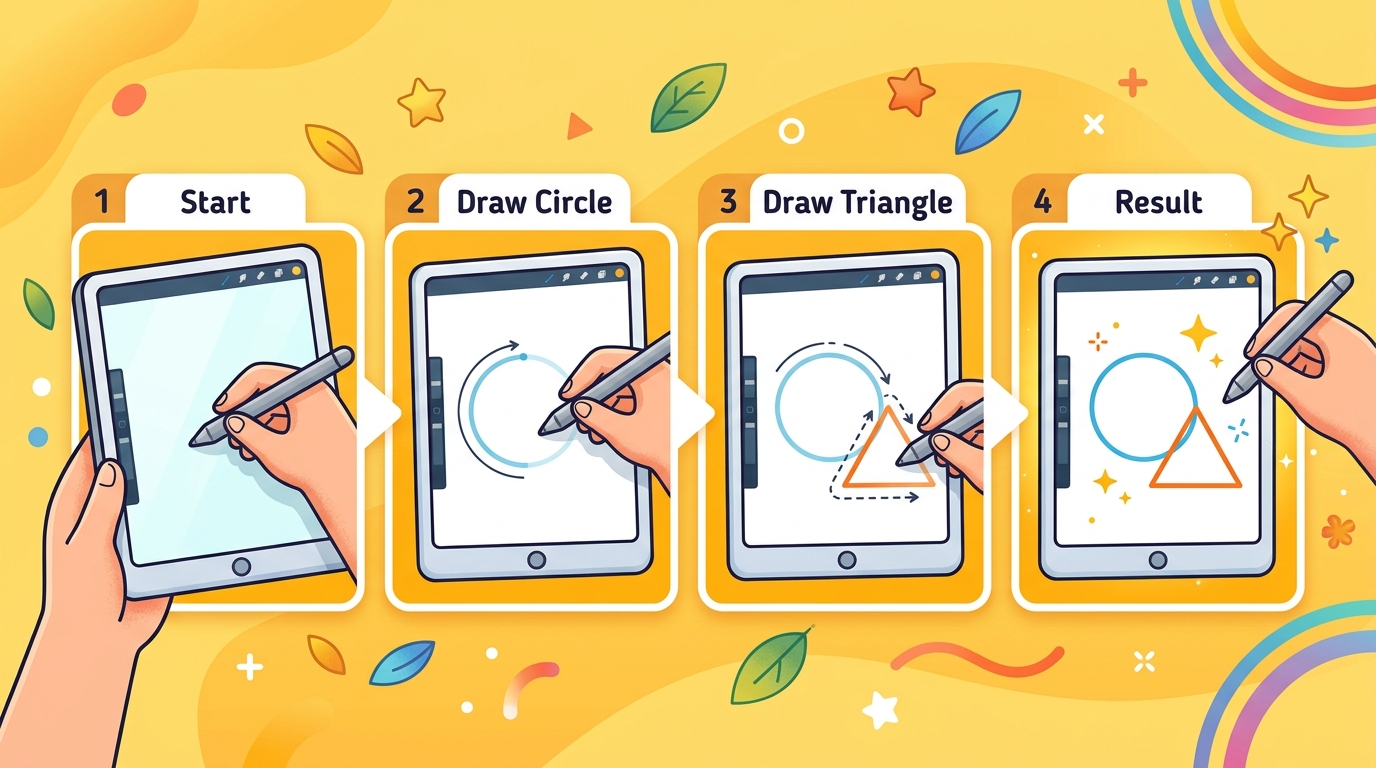
Speed drawing is not a diluted version of real drawing. It is a different skill with a different goal: real drawing aims to represent an object, while speed drawing aims to trigger recognition. Those often call for opposite decisions — accurate proportions can be worse than exaggerated ones, and detail frequently makes a sketch harder to identify rather than easier.
The good news is that recognition is a much lower bar than representation, and it can be reached by method rather than by talent.
Everything Is Six Shapes
Almost any object in a word bank can be assembled from a small vocabulary of primitives: circle, oval, square, rectangle, triangle, and line. Construction, not artistry:
- Car — rectangle + two circles + a smaller trapezoid on top
- House — square + triangle + a small rectangle for the door
- Person — circle + line + four lines
- Tree — rectangle + a cloud-like blob
- Cat — circle + two triangles + three lines each side
- Aeroplane — long oval + two triangles + a small vertical fin
Once you see objects as assemblies, the question stops being “can I draw a car?” and becomes “which shapes, in what order?” — a question anyone can answer without artistic ability.
The Twenty-Second Method
Four steps, in this order, every time:
- Seconds 0–5: the biggest shape. Draw the single largest component, filling most of the canvas. Bigger than feels comfortable — small drawings are unreadable on someone else’s phone.
- Seconds 5–10: the second and third shapes. Now the silhouette exists. At this point a fast guesser may already have it.
- Seconds 10–15: the signature feature. The one element that distinguishes this object from everything similar — the giraffe’s neck, the chef’s hat, the shark’s dorsal fin. Exaggerate it. This is the highest-value step and the one beginners skip.
- Seconds 15–20: colour, if it disambiguates. Fill only where colour carries meaning — red for apple, yellow for banana. Decorative colour is wasted time.
Twenty seconds in, you have a recognisable object and sixty seconds in reserve. That reserve is the entire point: it is what lets you add context, or start a second attempt from a different angle, if the room is not getting it.
Budgeting the Full Eighty Seconds
Most players spend the whole round on one continuously-improving drawing. A better allocation:
- 0–20s — the four-step method above. Object is now recognisable.
- 20–40s — watch the chat. If guesses are close, add the one detail that closes the gap. If nobody is near, stop adding.
- 40–60s — if still unsolved, add context rather than detail: habitat, a scale reference, the object being used. Four strokes, not forty.
- 60–80s — if still unsolved, clear a corner and draw a completely different interpretation. A second angle beats a more polished first one.
The discipline is in the 20–40 second window. The instinct is to keep refining; the correct move is usually to stop and read the room.
The Shorthand Everyone Already Knows
A shared visual vocabulary exists across cartoons and comics worldwide, and using it is far faster than inventing your own:
- Motion — short parallel lines trailing the object
- Impact — a spiky star burst at the contact point
- Sleep — three Z’s rising diagonally
- Thought — a bubble made of small circles
- Speech — a bubble with a pointed tail
- Heat — three wavy lines rising
- Cold — jagged lines and a shivering figure
- Smell — curling wavy lines from the source
- Idea — a lightbulb above the head
- Sound — arcs radiating outward
These do most of the heavy lifting for verbs and abstract prompts, which are otherwise the hardest words in any bank. Learning ten symbols converts an entire difficulty tier into something approachable.
Exaggeration Beats Accuracy
This is the hardest idea to accept, and the most useful. A correctly proportioned giraffe is harder to identify than one whose neck is three times too long, because recognition works on distinctive features rather than on accuracy.
- Rabbit ears — longer than the body
- Elephant trunk — thicker and lower than reality
- Shark fin — twice the height it should be
- Chef’s hat — taller than the chef’s head
- Snail shell — oversized, with an obvious spiral
Caricature is not a shortcut around proper drawing. It is the correct technique for this problem, because it amplifies exactly the signal the guesser is scanning for.
Four Habits That Waste Your Round
- Starting with the face. Beginners draw an eye, then another eye, then a nose, then discover fifty seconds have gone and there is no body. Always outermost shape first.
- Erasing instead of undoing. Careful erasing costs five to ten seconds. Undo removes the last stroke instantly.
- Drawing small. A small neat drawing in the middle of the canvas is much harder to read than a large rough one, especially for players on phones.
- Clearing at forty seconds. A full clear that late leaves you too little time and resets the room’s thinking. Clear a corner and redraw beside your first attempt instead.
Drawing Verbs and Abstract Words
Concrete nouns are the easy case. When the prompt is an action or an idea, the method changes: instead of drawing the thing, you draw a scene in which the thing is obviously happening.
- Running — a stick figure leaning forward, plus motion lines behind
- Sleeping — a horizontal figure, a pillow rectangle, three Z’s
- Cooking — a pot, heat waves, a figure holding a spoon
- Swimming — a wavy waterline, a head above it, arcs for splashing
- Reading — a seated figure and an open V for the book
- Cold — a figure, jagged shiver lines, a snowflake
The pattern is always the same: a figure, one prop, one symbol. Three components, roughly fifteen seconds. Once you notice that verbs decompose this reliably, the category stops being the one you dread during word selection.
Practising Without the Pressure
None of this should be attempted first in a live match. A new construction habit feels slower before it feels faster, and under an 80-second clock with five people watching you will revert within a turn.
Solo Draw gives you a random word and no timer. Ten minutes spent drawing ten objects using the four-step method — biggest shape, supporting shapes, signature feature, colour — is enough for the sequence to start feeling automatic. After that it survives contact with a real round.
Why This Is Worth Learning
The scoring makes the case. A drawer earns 40 points for every player who solves the word, so in a six-player room the difference between a sketch three people get and one all five get is 80 points — per turn, every turn. Across a four-round match that is a few hundred points, from construction method alone.
And none of it requires talent. Six shapes, four steps, ten symbols, and a bias toward exaggeration. Players who adopt the method usually see their placement improve within two or three matches, without ever having learned to draw in any conventional sense.