
Last updated: August 16, 2026
Pictionary Scoring Explained: How to Actually Win
The formula, worked through with real numbers — and the three counter-intuitive conclusions it leads to.
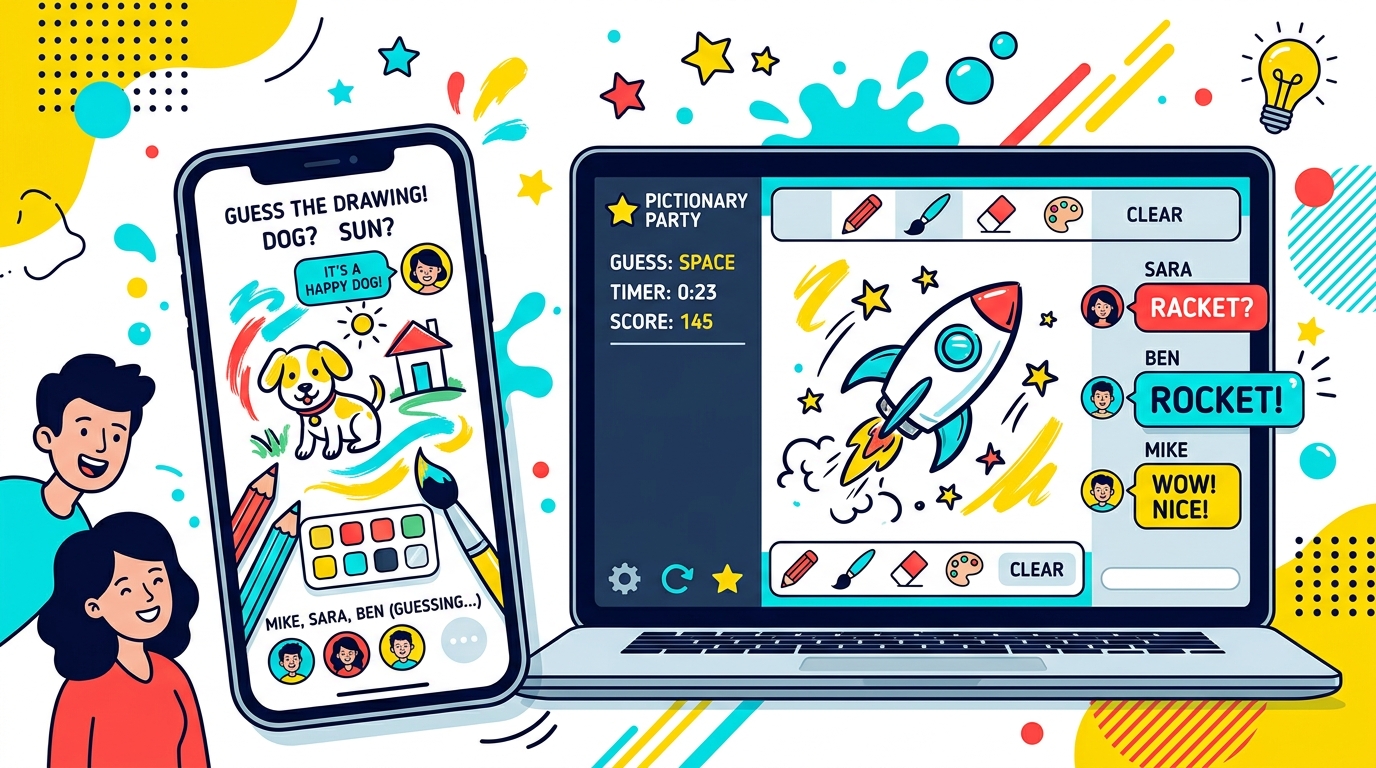
Almost every player picks up online Pictionary by intuition: guess quickly, draw clearly, hope for the best. That works, but it leaves points on the table, because two of the three most important strategic conclusions are the opposite of what intuition suggests.
This guide sets out the actual scoring rules and works through the consequences. There is a little arithmetic, but nothing beyond addition — and it is worth it, because the conclusions apply to every round you play.
The Rules in Full
There are exactly two ways to score.
Guessing correctly awards a flat 100 points, plus a speed bonus of up to 100 more in proportion to how much of the 80-second drawing clock remains when you answer:
points = 100 + (100 × seconds remaining ÷ 80)
Drawing awards 40 points for every player who guesses your word correctly. If nobody solves it, you score nothing at all.
That is the entire system. No penalties for wrong guesses, no bonus for artistic quality, no deduction for running out of time.
What a Guess Is Actually Worth
Running the formula across the clock:
- Instantly (80s left) → 200 points — the theoretical maximum
- After 10 seconds (70s left) → 187 points
- After 20 seconds (60s left) → 175 points
- After 40 seconds (40s left) → 150 points
- After 60 seconds (20s left) → 125 points
- After 75 seconds (5s left) → 106 points
- Not at all → 0 points
Conclusion one: never stop guessing. The whole speed bonus is worth 100 points — but the gap between a last-second guess and no guess is also 100. Being fast is worth exactly as much as bothering at all. Most players intuitively give up on a word once they feel they have fallen behind, and that single habit costs more points across a match than any drawing weakness.
What Drawing Is Actually Worth
The drawer’s score scales with the number of solvers, so it depends on room size:
- 3 other players, all solve → 120 points
- 5 other players, all solve → 200 points
- 7 other players, all solve → 280 points
- 7 other players, two solve → 80 points
- Nobody solves → 0 points
Conclusion two: pick the boring word. In a full room, a word everyone gets is worth 280 points — more than the maximum possible guess. A clever, difficult word that two people eventually decode is worth 80. The scoring system rewards comprehension, not ambition, and by a factor of three or four.
This is the conclusion players resist most. During your 15-second word choice, the instinct is to take the interesting option. The maths says take the one your room will recognise.
Where a Match Is Actually Decided
Consider a 6-player, 4-round match: 24 turns, of which you draw 4 and guess 20.
- Guessing ceiling: 20 guesses × 200 = 4,000 points, if you solve everything instantly. Unreachable in practice.
- Drawing ceiling: 4 turns × 200 = 800 points, if all five opponents solve every word you draw. Genuinely achievable.
Conclusion three: matches are won while guessing, but lost while drawing. Your guessing accounts for the large majority of available points, so consistency there dominates. Meanwhile the realistic drawing range runs from 0 to 800, and a couple of scoreless drawing turns is a hole that is very hard to climb out of.
Practically: guess relentlessly on every single turn, and when you draw, optimise ruthlessly for being understood rather than for being impressive.
A Worked Comparison
Two players, same 6-player 4-round match, different approaches.
Player A — the artist. Draws beautifully and picks ambitious words. Averages 3 solvers per drawing turn (120 points × 4 = 480). Concentrates on drawing and only guesses when confident, solving 12 of 20 at an average of 160 points (1,920). Total: 2,400.
Player B — the communicator. Draws crudely but picks obvious words. Averages 5 solvers (200 × 4 = 800). Guesses constantly, solving 18 of 20 but often late, averaging 140 points (2,520). Total: 3,320.
Player B wins by nearly 40% while being a demonstrably worse artist. The gap comes from two places: six extra solved words, and 320 extra points from picking words the room could actually get. Neither requires any drawing ability.
Practical Rules
- Type constantly. Wrong guesses are free and correct ones are hidden from other players. There is no reason to filter.
- Guess to the buzzer. 106 points is not a consolation prize; it is most of a guess.
- Take the obvious word. Comprehension pays three to four times what difficulty does.
- Get a stroke down immediately. A drawer idle for 20 seconds is treated as away and the turn passes — the only way to score a guaranteed zero.
- Pivot at forty seconds. If nobody is close, redraw from a different angle. Converting two more guessers is worth 80 points; polishing a sketch nobody understands is worth nothing.
- Bigger rooms raise the stakes of drawing. With 8 players, one well-chosen word is worth 280 — treat your drawing turns as the high-variance moments they are.
Two Situations Worth Thinking About
You are far behind going into the last round. The instinct is to gamble on a hard word for a dramatic comeback. The maths says the opposite: a hard word nobody solves is zero, while an easy one in a full room is up to 280 — which is a bigger single-turn swing than any gamble offers. The high-variance play and the high-value play are the same thing here, and it is the boring word.
You are drawing for a room that keeps guessing wrong. Every player still stuck is 40 points you have not collected. If three people are stranded, converting them is worth 120 — far more than any refinement to a drawing the other two already solved. Draw for whoever has not got it yet, not for the people who have.
Why There Is No Penalty for Guessing Wrong
It is worth noticing what the scoring system deliberately leaves out. There is no deduction for a wrong guess, no cap on how many you may submit, and no reward for being the only person to solve something. Every one of those omissions pushes in the same direction: guess more, share more, communicate more.
A system that penalised wrong guesses would produce a quiet game where people wait until they are certain — which is both less fun and less social. Understanding that the rules are built to encourage noise is itself a strategic insight: the game is not asking you to be careful.
The Short Version
If you remember one sentence: the game rewards being understood, not being good. Every scoring rule points the same way. The player who draws a lopsided but unmistakable house and types forty guesses a round will beat the player producing careful architectural sketches in near silence, every time.